
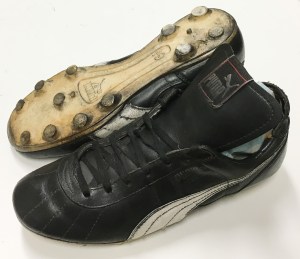

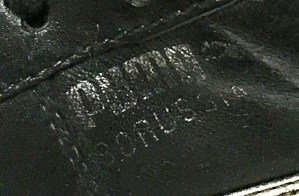
ディエゴ様実使用のスパイクです。
These boots are actually used by Diego Maradona.
というのはまったくのウソです。
This is a complete lie.
古くてぼろい、誰が使ったかわからない中古のボルシアです(たぶんアルゼンチン製)。
They are old and tattered, used Borussia football boots (probably made in Argentina) that I don’t know who used them.
ただ、サイズはUKかUSかわかりませんが、ディエゴ様サイズ(6.5)で、スパイクに詳しくない人であれば、そのまま騙されてしまうかもしれません。
However, I am not sure if the size is UK or US, but it is Diego’s size (6.5), and if you are not familiar with football boots, you might be fooled as it is.
というのも、これまで何度も紹介してきましたが、このモデルはいろいろなレジェンドの実使用品としてオークションに出品されたり、博物館に展示されたりしています。
This is because, as I have mentioned many times before, this model has been sold at auctions and displayed in museums as actual used boots of various legends.
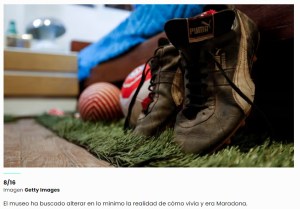
アルゼンチンの博物館
Diego Museum in Argentina
以下オークション
Below are some examples of auctions I have seen.
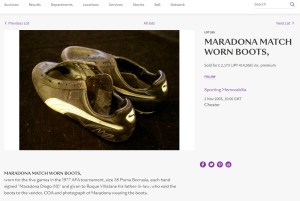
77年に使った?
Diego used in 1977?
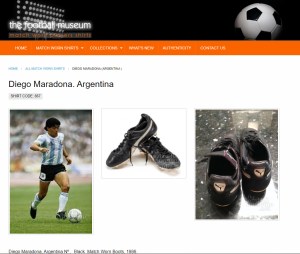
こちらは86年?
This one was used by Diego in 1986?
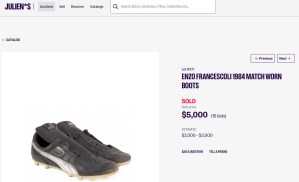
ウルグアイの英雄・フランチェスコリ選手も84年に履いていた?
Did Uruguayan hero Francescoli also wear them in 1984?
クライフ選手も履いていた?
Did Cruyff wear them too?
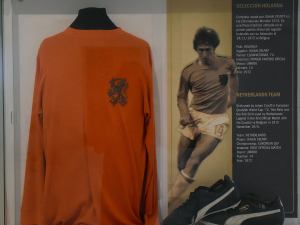 こちらも博物館展示品です。このユニフォームは70年代前半ですけど…。このスパイクもそのころにあったということですか?
This is another museum exhibit. This uniform is from the early 70’s…. Does this mean that these boots were also around then?
これらがすべて真実だとすると、70年代からこのモデルはあったということになりますが、70年代のプーマ「BORUSSIA」というモデルは黄色ラインで、もう少し古臭い感じです。
If all these are true, then this model has been around since the 70’s. The Puma “BORUSSIA” model from the 70’s has a yellow line and looks a bit more old-fashioned.

プーマ関連のHPにも掲載されています。
You can also find them on Puma-related websites.
昔から(70年代から)、欧州のプロ選手は試合ではほとんど取替え式スパイクを履いており、高級モデルの場合、取替え式の方が固定式よりずっと高価で、モデル数も豊富でした。
For a long time (since the 70’s), European professional players wore mostly changeable studs boots in games, and in the case of high-end models, changeable studs boots were much more expensive than fixed studs ones, and there were many models available.

74年ごろにデビューした西ドイツ製のモデル番号No.380のワールドカップ(WORLD CUP)は、それ以後プーマの固定式フラッグシップモデルとして、長く製造され、多くの名選手に愛用され続けました。
The World Cup, model No. 380, made in West Germany, debuted around 1974 and was manufactured for a long time thereafter as PUMA’s fixed studs flagship model, and continued to be used by many famous players.
ただ、70年代後半から日本では名前が変わり、あのベルトマイスター(Weltmeister ベルマイ)になりました。
However, the name changed in Japan in the late 70’s and became that Weltmeister.
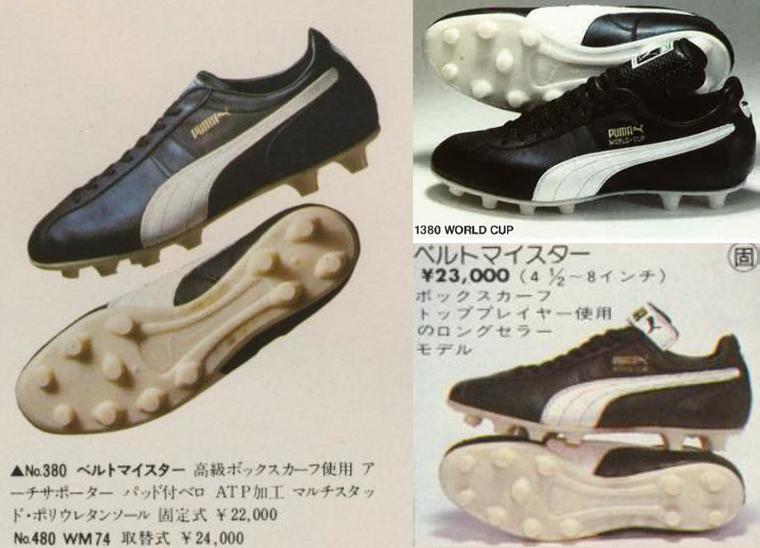
左は70年代後半の日本の広告。まだシュータンは黒で、長さも短かかったようです。80年代になると、白シュータンに変更されました。右上は海外版カタログで、モデル番号380ですが、名前は「WORLD CUP」のままです。
On the left is a Japanese PUMA advertisement from the late 70s. In the 80’s, the shoes tongue were changed to white. The upper right is an overseas catalog, model number 380, but the name is still “WORLD CUP”.
同時期のもう一つの固定式高級モデルは「シーザーメノッティ」(Cesar Menotti シーザー)でモデル番号は370です。
Another fixed studs high-end model from the same period is the “Cesar Menotti“, model number 370.
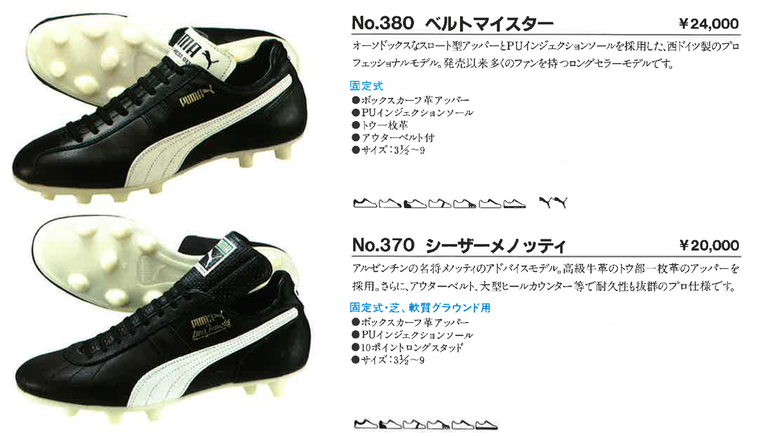
80年代前半の日本の広告。日本ではベルトマイスターは側面のモデル名表示がなくなったようです。シーザーは10本スタッドでシュータンの種類が多々存在しました(黒、T字、白)。
アッパーで大きな違いはつま先の作りで、ベルマイは2枚革ですが、シーザーはステッチのみの1枚革です。
Japanese PUMA advertisement from the early 80s. It appears that Weltmeister no longer displays the model name on the side in Japan. The Cesar Menotti had 10 studs and many types of shoe tongue (black, T-shaped, white).
The major difference in the upper is the toe, which is made of two pieces of leather for the Weltmeister, but only one piece of leather with stitching for the Cesar Menotti.
南米(今回はアルゼンチンの事情)は80年代でも、ディエゴ様をはじめ、固定式ソールを好む選手もたくさんおられ、プーマの高級固定式モデルは日本同様人気だったようです。
In South America (in this case, Argentina), even in the 1980s, there were many players, including Diego, who preferred fixed studs soles, and Puma’s high-end fixed studs models seemed to be as popular as in Japan.
ただ、アルゼンチン国内の当時のプーマスパイク、もしくはその広告の情報は日本では乏しく、なかなか正確なことを知ることができないのが実情です。
However, information on PUMA boots or their advertisements in Argentina at that time is scarce in Japan, and it is difficult to get an accurate information.
シーザーについては、アルゼンチンの有名誌「El Gráfico」の こちらの広告が唯一これまでに入手できたものでした。
As for Cesar Menotti, this advertisement in the famous Argentinean football magazine “El Gráfico” is the only one I have been able to obtain so far.
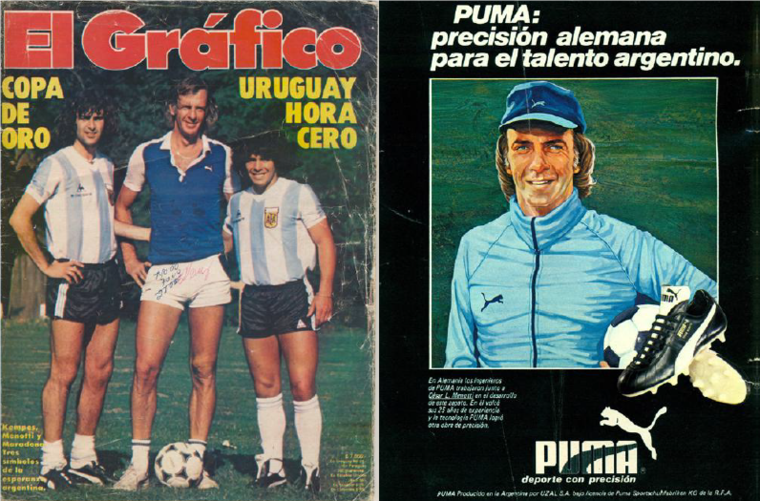
この「T字シュータン」は製造期間が短かったため、なかなか現物を見ることが難しいモデルです。
This ” T-shaped shoe tongue ” model was manufactured for a short period of time, so it is difficult to see the original.
このころ、その才能を日本人が初めて目の当たりにした79年Wユースで、ディエゴ様はこのタイプのスパイクを履いて大活躍されました。
Around this time, Diego wore this type of boots and played a very active role in the 1979 World Youth, where the Japanese witnessed his talent for the first time.

アッパーは紛れもなくシーザーなのですが、スタッドは12本のタイプでした。
The upper was unmistakably Cesar Menotti, but the studs were of the 12 studs type.
最近、こちらの「El Gráfico」(1983年)にあった広告で、驚くべき事実がわかりました。
A recent advertisement I found in “El Gráfico” (1983), shown here, revealed a surprising fact.
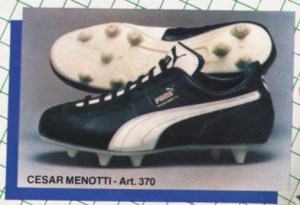
シーザーも同じ広告に載っていますが、
Cesar Menotti’s is in the same ad, though,
なんといっても目玉はこちら、
The main highlight, after all, is this one,
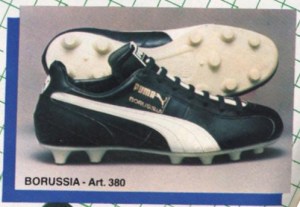
由緒あるモデル番号380のスパイク名は「BORUSSIA」でした。つま先は2枚革ですが、シュータンは独特で、センターに白ラインが入っており、当時、日本でも欧州でも380モデルでは見かけないデザインでした(他のモデルでは同じタイプがありました)。
The venerable model number 380 boots name was “BORUSSIA”. The toe is two pieces of leather, but the shoe tongue is unique, with a white line in the center, a design not seen on the 380 model in Japan or Europe at the time (other models had the same type).
ちなみにシーザータイプの白シュータンのベルマイは日本で短期間存在したようです。
Incidentally, it seems that Cesar Menotti-type Weltmeister with white shoe tongue existed in Japan for a short period of time.

このころのプーマのシュータンパターンはカオスです。
Puma’s shoe tongue pattern at this time is chaotic.
これらのことから、このころのプーマの高級固定式スパイクは世界的にモデル番号は380で共通でしたが、
These, though Puma’s high-end fixed studs boots at this time shared the same model number of 380 worldwide,
日本=ベルトマイスター
Japan = Welltmeister
ヨーロッパ=ワールドカップ
Europe = World Cup
アルゼンチン(南米)=ボルシア
Argentina (South America) = Borussia
別々の名称で、シュータンデザインも違っていたようです。
They had different names and different shoe tongue designs.
80年代前半、日本でも欧州でも名選手がベルトマイスター、ワールドカップを履いていたように、ボカや代表で、ディエゴ様がボルシアを愛用していました(81年ごろ)。
ただ、バルサに移籍された82年以降、つま先2枚革で白シュータンのモデルをずっと履いていたと思います。
In the early 80’s, Diego used to wear Borussia in Boca and the national team (around 1981), just as famous players in Japan and Europe used to wear Weltmeister and World Cup. However, after 1982, when he moved to Barça, I think he always wore the model with two leather toes and white shoe tongue.

きっと、ディエゴ様が欧州に行かれる前で、アルゼンチンの人の脳裏には、ディエゴ様が自国内で大活躍していた時のスパイク=ボルシアと刷り込まれたのだと思います。その結果、その後のディエゴ様のスパイクはどんな種類であっても、アルゼンチンの人はボルシアと信じて疑わないようです。
I am sure that before Diego went to Europe, the Argentinean people’s brains were imprinted with the idea that the boots used by Diego when he was very active in his own country were Borussia.
As a result, no matter what kind of boots Diego used after that, Argentine people seem to have no doubt that it was Borussia.
もしよろしければ、それが誤解だということが、こちらをご覧いただければわかると思います。
If everyone who read this story like, you can see here that this is a misunderstanding.
ただ、同時期に日本にもボルシアという名前のモデルがありましたが、
However, there was a model named Borussia in Japan at the same time, though, this seems to complicate the story further,
1万円もしない、ある意味シーザーの廉価版モデルでした。しかも今回紹介しているスパイクと、マーク以外は瓜二つです。
It was a low-priced model of similar to Cesar Menotti in a sense, costing less than 10,000 yen. Moreover, it is a duplicate of the boots introduced here, except for the mark of shoe tongue.
このような理由で、「ボルシア」という同じ名前のスパイクの認識に、日本(一般向けの安物)とアルゼンチン(ディエゴ様御用達)では大きな乖離があるようです。
For this reason, there seems to be a big gap in the recognition of boots with the same name “Borussia” between Japan (cheap ones for general use) and Argentina (Diego’s favorite one).
その後、モデルNo.380のスパイクはどうなったのか?
After 90’s, what then happened to the model No. 380 boots?
まず、日本ですが、ご存じのように1986年ごろから「Made in Japan」の名品パラメヒコが発売され、2020年ごろまで生産され続けました。
First of all, in Japan, as you know, the famous “Made in Japan” Paramexico was launched around 1986 and continued to be produced until around 2020.

デビュー当時のシュータンデザインのパラメヒコ
Paramexico with its debut shoe tongue design
日本でのプーマ固定式トップモデルは完全に、西ドイツ製のベルマイから国産のパラメヒコになってしまい、ベルマイは93年ごろに廃版となりました(後年は名前もワールドカップになり、台湾で作られていたようです)。
The Puma fixed studs top model in Japan completely changed from the West German-made Weltmeister to the domestically produced Paramexico, and the Weltmeister was discontinued around 1993 (in later years, the name also became World Cup, and it was made in Taiwan).
欧州ではもちろんパラメヒコは販売されず、ワールドカップは80年代後半まで生産されました。
The Paramexico was of course not sold in Europe, and the World Cup was produced until the late 80s.

イタリアから入手した80年代後半のワールドカップ(ソールは交換済み)
World Cup from the late 80’s obtained from Italy (soles have been replaced).
ただ、その後のワールドカップはそれまでとは似ても似つかぬモデルになってしまいました。このモデル以降、ワールドカップというモデル名は使われなくなったと思います。
However, the subsequent World Cup models were not similar to the previous ones. After this model, I think the model name “World Cup” was no longer used.
ちなみに、90年代は固定式トップモデルも「KING」になってしまいました。アルゼンチンの人は90年W杯のディエゴ様のスパイクですら、ボルシアと思っている人が多いのには驚きます。
Incidentally, in the 90’s, the fixed studs top model also became “KING“. I am surprised that many people in Argentina think that even Diego’s boots for the 1990 World Cup is Borussia.
最後に南米ですが、80年代後半は、少なくともディエゴ様は取替え式も固定式も自分の特注モデルがあり、おそらく自分の名前が入ったモデル名で、ボルシアとは記されていなかったと思います。
Lastly, in South America, at least in the late 80’s, Diego had his own custom-made models, both replaceable and fixed studs, and they probably had his name on them and were not labeled “Borussia”.
そのころの南米選手でプーマ固定式スパイク愛用者をあまり調べていないのですが、日本で開催されたトヨタカップではプリメイロやパラメヒコを好んで履いていた記憶があります。
I have not been able to do much research on South American players who used Puma fixed studs boots at that time, but I remember that they preferred to wear Primeiro or Paramexico at the Toyota Cup held in Japan.
さて、そろそろ今回のモデルについてですが、おそらくディエゴ様が履いていたボルシアの復刻版として作られたアルゼンチン製のスパイクではないかと思います。
Now, it is time to talk about the model of this time, which I think is probably the Argentine-made boots made as a reissue of the Borussia that Diego wore in 1981.
広告画像がありましたが、いつごろのものかは不明です。
There was an advertising image, but it is unclear when it was taken.
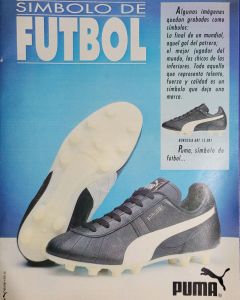
かっこいいモデルだとは思いますが、そもそもつま先部分がシーザータイプですし、どうせならシュータンもセンターの白ラインやマークも似せてほしかった…。
名前が同じだから、日本のボルシアを参考にしてしまったのでしょうか?
I think it is a cool model, but the toe part is a Cesar Menotti type to begin with, and I wanted the shoe tongue and the white line in the center and mark to be similar anyway….I wonder if they made a reference to the Japanese Borussia because the name is the same?
前述しましたが、このモデルはまことしやかに、博物館にも展示されることがあるのですが、一番まともな見せ方は、こちらだと思います。
As I mentioned before, this model is sometimes displayed in museums, as well, but I think this is the most appropriate way to show it.
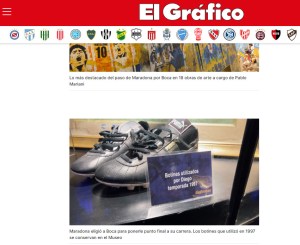
ディエゴ様引退のころ(97年)のスパイクだそうです。まあそれなら納得できるかな。
しかし、70年代から97年まで、まったく姿が変わらないスパイクはないと思います。
These boots are from around the time of Mr. Diego’s retirement (1997). Well, I guess that makes sense.
However, I don’t think there is any boots that have not changed its appearance at all from the 70’s to 1997.
ボルシアに限らず、ディエゴ様の実使用品について、本物と言えそうなものはめったになく、このモデルが80年代に使用されたことはまず有り得ないというのが持論です。
It is my opinion that there are very few Diego’s boots that can be said to be authentic, not only for Borussia, and that it is impossible for this model to have been used in the 80’s.
80年代のモデル番号380のボルシア(日本ではベルトマイスター、欧州ではワールドカップ)で、おそらく本物のディエゴ様実使用品はこちらだと思います。
I think that this is probably the authentic Diego’s real Borussia (Weltmeister in Japan, World Cup in Europe) with model number 380 from the 80’s.
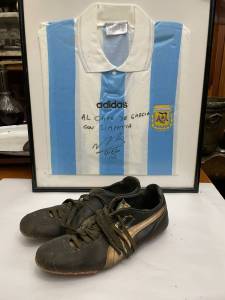
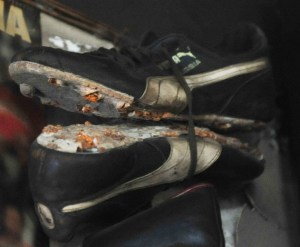
たぶん、これらのディエゴ様支給品が眠っていたアルゼンチンのディエゴ様の旧家にあったもので、今は所在はわかりません。
こちらはつま先もシュータンも80年代のNo.380のボルシアそのもののようです。仮にディエゴ様実使用でなくてもスパイクマニアにとってはとても魅力的です。
These boots probably belonged to Diego’s old house in Argentina, where these Diego’s exclusive-issue boots were also kept, but I do not know where these boots are now.
The toe and the shoe tongue of this one look like the Borussia No.380 of the 80’s. Even if Diego didn’t use them, they are very attractive to the boots enthusiasts like me.
もし可能であれば、これこそを由緒ある博物館に展示してほしいものです。
If possible, we would like to see this one exhibited in a venerable museum.
蛇足ですが、日本でも自国製のベルトマイスター復刻版がありました。
As additional information, there was also a Japanese-made Weltmeister reissue model.

Jリーガーも使うよいモデルでしたが、オリジナルのベルマイやパラメヒコのような長寿モデルにはなりませんでした。
It was a good model used by Japanese professional players, but it was discontinued after a few years and did not have the longevity of the original Weltmeister and Paramexico models.
また、シュータンセンターの白ラインを復活させたモデルもありました。
There was also a model that revived the white line in the center of the shoe tongue.
今では日本でベルトマイスターのモデル名を知る人はわずかなシニアサッカーファンのみになってしまいましたが、ボルシアはアルゼンチンでは今でも現役モデルです。
Now only a few senior football fans in Japan know the name of the Weltmeister model, but the Borussia is still an active model in Argentina.
現行版は持っていませんが、今回のモデルの後継モデルは2つほど入手しました。
I do not have the current version, but I have obtained two successors to this model.


ボルシアは、まさにアルゼンチンのパラメヒコとも言えるすばらしい長寿モデルで、しかもアッパーは着実に進化しつつ、ソールはオリジナルのパターンを維持しているというのがすごいです。
The Borussia is a wonderful long-lived model that can truly be called an Argentinean Paramexico, and it is amazing that the soles have maintained the original pattern while the uppers have steadily evolved.
この2種類はまだなんとか見つかるのですが、今回のモデルは見るからにボロボロでしたが、やはり1足は持っておくべきと思い、アルゼンチン国内フリマで発見後、以前お世話になった方に手伝っていただき入手しました。
I could still manage to find these two types of boots, but this time, although the model was in tatters, I thought I should have a pair, and after finding them at a flea market in Argentina, I obtained them with the help of a person living in Argentina.
一時期はあまり良い印象がなかったボルシアですが、これからもぜひ進化を続けながら、日本では手に入らなくなってしまった、貴重なトラディショナルソールのモデルとして残していってほしいものです。
I hope that they will continue to evolve, and keep them as a valuable model with a traditional sole, which is no longer available in Japan.
(2024年2月26日)
追記
Postscript.
アルゼンチンにはborussiaの神話という言葉があるそうで、おそらくこのモデルはアルゼンチン産のアルゼンチンを代表する、アルゼンチンの誇りのようなブーツのようです。
There is a myth of borussia in Argentina, and perhaps this model seems to be a boot that represents Argentina and is the pride of Argentina, made in Argentina.
それは、割と安価な皮革の材料で作られ、そしてリーズナブルな価格でありながら、マラドーナのような超一流のプロ選手から、少年から大人まで幅広い一般プレーヤーに愛され続けている名品ブーツと認識されているからのようです。
It seems to be because they are made of rather inexpensive leather materials, and despite their reasonable price, they are recognized as masterpiece boots that continue to be loved by a wide range of general players from boys to adults, from top-notch professional players such as Maradona.
これぐらい使い込まれている方が、アルゼンチンではまさしくBorussiaのあるべき姿なのかもしれません。
This level of use may be exactly what Borussia should be like in Argentina.
